Wednesday, April 27, 2016

COMIC BOOK RETROVIEW: PLASTIC MAN In The Silver Age, Part 2

Continuing a look back at Plastic Man in the '60s.  You can read Part 1 HERE
                          

I don't recall anyone ever saying anything positive about the 1960s Plastic Man series, which was DC's first attempt to revive the classic 1940s superhero it purchased from the defunct Quality Comics line in the '50s.  Of course, it would border on heresy to claim these '60s books could compare to the sheer comics genius of Plas creator Jack Cole's original Plastic Man tales in the '40s.  So yeah, this stuff clearly ain't Jack Cole.  But was it really that bad?

The task of updating Plastic Man fell to a couple of comics veterans, writer Arnold Drake and artist Gil Kane.  Drake had a wealth of experience in writing both adventure and humor comics; he created the misfit superhero team The Doom Patrol (and, later on, both Deadman for DC Comics and The Guardians Of The Galaxy for Marvel), and he wrote DC's long-running humor books The Adventures Of Jerry Lewis and The Adventures Of Bob Hope.  Kane's work on Green Lantern and The Atom had already made him a fan favorite.  Plastic Man's fate wasn't exactly in the hands of novices.

Still, it didn't really work.  It wasn't just that this new Plastic Man didn't have any of the zest and ingenuity of the original; it didn't have anything special of its own to offer, either.  It was a superhero sitcom, not altogether different from Drake's amiable, agreeable, and amusing work on Jerry Lewis, though somehow lacking...somethingThe Adventures Of Jerry Lewis was a fun title; Plastic Man was sorta fun, but not as much.

The new Plastic Man is introduced without a back story, a fait accompli, with no origin or explanation of the stretchy guy's powers.  Woozy Winks, the original Plastic Man's goofy sidekick in the '40s, is nowhere to be seen.  In Woozy's place, the Silver Age Plas has a new set of supporting characters:  his girlfriend Mike, aka wealthy and beautiful heiress Micheline De Lute the 3rd; his pal Gordon K. "Gordy" Trueblood, a pet store proprietor who wishes Plas would take the superhero biz more seriously; Mike's mother "Moms," or Micheline De Lute the 2nd, who despises that uncouth, good-for-nothing Plastic Man who has somehow captured her daughter's heart; Police Captain Matthew McSniffe, who hates Plastic Man even more than Moms does, and won't rest until he's proven that Plas is really a criminal, not a hero; the insidious Dr. Dome, Plastic Man's evil--but inept--arch-enemy; and Dr. Dome's daughter Lynx, a whip-wieldin' sex kitten who secretly lusts for Plastic Man's pliable bones.

Gil Kane's rendition of Plastic Man was only a slight modification of the original; Kane's Plas was more square-jawed, and he sported red leggings instead of bare legs, but was otherwise visually similar to classic Plastic Man.  Gil Kane was a comics legend, but Plastic Man is but a minor footnote in his long career; Kane's Plastic Man had none of the visual spark and pizazz of Jack Cole's character.  Nor did the script call for it.

By Plastic Man# 2, Kane was replaced at the drawing board by Win Mortimer. In Plastic Man # 7, it's revealed that the titular hero is, in fact, the son of the original Plastic Man, as Papa Plas and Woozy Winks come out of retirement to team up with the new guys.  Jack Sparling became the artist with Plastic Man # 8, and the book was cancelled after ten issues.


Plastic Man made but one extracurricular appearance in the '60s, teaming up with Batman in The Brave And The Bold # 76.  A Neal Adams cover was the best thing about the issue, as Bob Haney's story and artist Mike Sekowsky's loutish figures made the regular Plastic Man series look like Stan Lee and Jack Kirby by comparison.

Nostalgia interferes with my objectivity here.  1966's Plastic Man # 1 was the first time I'd ever seen Plastic Man in action, and DC's house ad for that issue was the first time I'd ever even heard of Plastic Man.  Up top, we asked the question:  Was DC's Silver Age Plastic Man series really that bad?  And, well...no, it wasn't that bad.  It just wasn't very good.  But it was harmless, and it was even occasionally fun.  And it served to introduce me to one of my all-time favorite characters.

Plastic Man's next appearance [SPOILER ALERT] was in 1971, as a surprise, unannounced guest star in The Brave And The Bold # 95.  With a cover-billed team-up of "Batman and...?," this issue ignored the '60s series and the son of Plas entirely, and brought back the original Plastic Man.  But now, Plas was played straight, bemoaning the fact that everyone thought he was a clown, a freak.  I was 11 when it was published, and I loved it.  Unlike the last time Batman and Plastic Man met in the pages of B & B, this time Bob Haney's script clicked for me, and Nick Cardy (perhaps my all-time favorite comics artist) turned in 22 pages of sheer brilliance.  You can argue that Plastic Man shouldn't be played straight--and, if pressed,  I'd probably agree with you--but, within its own parameters, this one worked very well for me.


But, that same year of 1971, I also finally had the opportunity to see Plastic Man as he was meant to be.  DC Special # 15 was devoted entirely to reprints of Jack Cole's Plastic Man.  I read Plastic Man's origin and first appearance (and discovered that he was originally gangster Eel O'Brien, not "Eels" O'Brien, as he'd been referred to in all Silver Age mentions), the origin of Woozy Winks, and more prime tales of Plastic Man at his best.  Mind blown.  This single-issue education taught me what Plastic Man should be, how he should look, how he should act, and rendered all other versions permanently beside the point. I'm still open to the idea of Plas played straight--check out Plastic Man's appearance in Justice by Jim Krueger, Alex Ross, and Doug Braithwaite for a stirring example of Plas fighting alongside Captain Marvel (another light-hearted hero) and the rest of the Justice League of America--but I know who the real Plastic Man is now.

The one.  The only.  The original Plastic Man.


Tuesday, April 26, 2016

COMIC BOOK RETROVIEW: PLASTIC MAN In The Silver Age, Part 1


Jack Cole's Plastic Man is rightfully regarded as one of the greatest comic-book creations of all time.  Cole's original Plas tales in the 1940s were kinetic, inventive, goofy, energetic, and irresistible; although the character has appeared many, many times in more recent years, no one has even come close to recapturing the magic of the original Plastic Man stories by Cole.  (Though I do want to add an honorable mention to the late '80s Plastic Man mini-series by Phil Foglio and Hilary Barta, which came the closest).

Still, I must confess that my love of Plastic Man predates my exposure to Jack Cole's wonderful work.  No, I became a Plas fan via 1966's Plastic Man # 1, DC Comics universally-reviled attempt to revive the character in the Silver Age.

History:  Plastic Man debuted in Police Comics # 1, cover-dated August 1941.  Police Comics and the subsequent Plastic Man comic book were published by Quality Comics, a very successful comics company in the '40s, also known for its aviator hero Blackhawk and its comic-book reprints of Will Eisner's The Spirit.  Plastic Man was originally a small-time crook named Eel O'Brien, involved in a botched robbery that left him exposed to some unidentified, acidic substance, and--no honor among thieves!--deserted by the other members of his gang.  O'Brien still managed to escape, and was later discovered and nursed back to health at a nearby monastery.  As he recovered, O'Brien discovered that the acid had given him super-elastic plastic powers, including the ability to change his appearance, and to stretch.  And to streeeeeeeeeeeetch.  And to really, really streeeeeeeeeeeeeetch.  Inspired by the kindness of the monk who'd saved him, O'Brien decided to change his evil ways, baby, and to dedicate his powers to fighting crime as the ever-pliable Plastic Man.

Plastic Man endured until the '50s, but Quality exited the comics biz in 1956.  Most of Quality's non-licensed properties were then sold to National Periodical Publications (alias DC Comics); DC continued a few of Quality's titles--Blackhawk, the war book G.I. Combat, the romance title Heart Throbs--but had no immediate need or use for the other Quality characters it acquired, including Plastic Man.

(In the early '60s, Plastic Man reprints turned up in Plastic Man comics published by Super Comics, a company that had acquired printing plates from various defunct Golden Age comics publishers.  Super Comics owner Israel Waldman apparently believed that possessing these plates gave him the right to publish them in his own line of comics.  He was mistaken. One presumes that DC was not shy in pointing this out to Waldman in regard to Plastic Man.)


In 1966, the success of the campy Batman TV series made superheroes more popular than ever.  DC already had a proven track record of reviving heroes from the '40s in new, revamped incarnations, beginning with the debut of the Silver Age version of The Flash in 1956.  Almost all of DC's successful revivals to date--Flash, Green Lantern, The Atom, Hawkman--had been new characters, with new costumes, new origins, and usually new secret identities, sharing only the titular names with their original Golden Age counterparts.  Hell, DC's most successful revival--by far!--didn't even fully share the name of its '40s inspiration, as The Justice Society of America was revived as The Justice League of America.  That one worked out really well for DC!

By 1965, though, the popularity of guest appearances by some of the original 1940s characters (now retroactively relegated to an alternate Earth dubbed Earth-Two) must have led editor Julius Schwartz to toy with the idea of straight revivals of Golden Age heroes, rather than new heroes with old names. Success in this endeavor was limited; two-fer revivals of Starman & Black Canary and Hourman & Doctor Fate did not survive past two-issue trials, leaving The Spectre as the only such attempt to graduate to its own title.

Plastic Man was neither/nor.  It wasn't exactly the original character from the '40s, but it also wasn't a new character in the sense that Silver Age versions of The Flash, Green Lantern, The Atom, and Hawkman had been new characters.  Before introducing the new Plastic Man, an ersatz Plas appeared in the "Dial H For Hero" feature in House Of Mystery, as that book's dial-a-hero protagonist Robby Reed (who usually transformed into one of a series of heroes created for the strip) became "that famous crime-fighting hero of years ago,"  Plastic Man!


Of course, by the mid-'60s, the one and only original Plastic Man was no longer the only stretching hero on the stands.  The most famous stretchable superdoer was Mr. Fantastic, leader of The Fantastic Four over at Marvel.  DC had itself introduced no less than two new pliable protectors, evidently neither realizing nor caring that it owned the rights to Plastic Man himself:  Superman's pal Jimmy Olsen had his own occasional superhero identity as Elastic Lad, and a hero named The Elongated Man was introduced in The Flash and subsequently became Batman's back-up feature in Detective Comics.

Nonetheless, there was no Mr. Fantastic comic book, nor an Elastic Lad, nor anything but second-banana status for The Elongated Man. As a titular hero, Plastic Man had the stretching scene all to himself.

The Silver Age Plastic Man debuted in Plastic Man # 1, dated November-December 1966.  And that was my introduction to Plastic Man.


NEXT:  Not the one, not the only, not the original.  But still...PLASTIC MAN!

Monday, April 25, 2016

This Is Rock 'n' Roll Radio # 823

2016 is fired.

This Is Rock 'n' Roll Radio with Dana & Carl streams live every Sunday night from 9 to Midnight Eastern, exclusively at www.westcottradio.org

TIRnRR # 823:  4/24/16

THE RAMONES:  Do You Remember Rock 'n' Roll Radio? (Rhino, End Of The Century)
--
PRINCE:  When Doves Cry (Warner Brothers, The Hits/The B-Sides)
DAVID BOWIE:  Life On Mars? [2003 Ken Scott mix] (Columbia, Nothing Has Changed)
THE EAGLES:  Take It Easy (Asylum, Their Greatest Hits 1971-1975)
JEFFERSON AIRPLANE:  It's No Secret (RCA, Takes Off)
MERLE HAGGARD:  Mama Tried (Sony, Super Hits, Vol. 2)
DRESS CODE:  I Knew (Semaphore, Alone In A Crowd)
EMERSON LAKE & PALMER:  Lucky Man (Razor & Tie, Come And See The Show)
EARTH, WIND & FIRE:  September (Columbia, The Eternal Dance)
JIM BABJAK'S BUZZED MEG:  Lost In Love (Tex Rem, The Music From Jim Babjak's Buzzed Meg) [for Betty Babjak]
THE BEATLES:  Tomorrow Never Knows (Apple, Revolver) [for Sir George Martin]
--
2016 can pack its bags.  We're starting over right here:
--
EYTAN MIRSKY:  This Year's Gonna Be Our Year (M-Squared, Year Of The Mouse)
THE MORELLS:  Let's Dance On (Hightone, Think About It)
CRAZY ELEPHANT:  Gimme Gimme Good Lovin' (Varese Sarabande, VA: Bubblegum Classics Volume Two)
JOSIE & THE PUSSYCATS:  You've Come A Long Way Baby (Rhino Handmade, Stop, Look, & Listen!)
PRINCE:  I Could Never Take The Place Of Your Man (Warner Brothers, The Hits/The B-Sides)
THE BANGLES:  Manic Monday (Columbia, Different Light)
--
TOMMY & THE ROCKETS:  Miss You So Much (Kool Kat Musik, Beer And Fun And Rock 'n' Roll)
THE BEVIS FROND:  Hit Squad (Rubric, Hit Squad)
GLADYS KNIGHT & THE PIPS:  Theme From "Valley Of The Dolls" (Motown, Silk N' Soul)
THE ASSOCIATION:  Along Comes Mary (Warner Brothers, Greatest Hits!)
PRINCE:  When You Were Mine (Warner Brothers, The Hits/The B-Sides)
CHRIS VON SNEIDERN:  Annalisa (Heyday, Sight & Sound)
--
THE MONKEES:  Oh My My (Rhino, Changes)
HINDU LOVE GODS:  Raspberry Beret (Rhino, WARREN ZEVON:  Genius)
PRINCE:  U Got The Look (Warner Brothers, The Hits/The B-Sides)
JETHRO TULL:  Locomotive Breath (Chrysalis, The Very Best Of Jethro Tull)
MR. ENCRYPTO:  The Last Time [a cappella] (unreleased expanded mix)
RONNIE LANE & SLIM CHANCE:  Ooh La la (Universal, Ooh La La)
--
COLMAN GOTA:  Back In Time (n/a, Tape)
R.E.M.:  Driver 8 (IRS, And I Feel Fine...)
PRINCE:  I Wanna Be Your Lover (Warner Brothers, The Hits/The B-Sides)
THE THREE O'CLOCK:  With A Cantaloupe Girlfriend (Rhino, VA:  Children Of Nuggets)
1.4.5.:  Your Own World (Beautiful Sounds, Rhythm n' Booze)
JOHNNY THUNDERS & THE HEARTBREAKERS:  Chinese Rocks (Jungle, L.A.M.F.)
--
THE RAMONES:  Now I Wanna Sniff Some Glue (Rhino, Ramones)
HAWKWIND: Motorhead (Cherry Red, Warrior On The Edge Of Time)
BADFINGER:  Baby Blue (Apple, Straight Up)
CHRIS FARLOWE:  Paint It Black (Repertoire, The Art Of Chris Farlowe)
PRINCE:  I Feel For You (Warner Brothers, The Hits/The B-Sides)
THE MICKEY FINN:  Garden Of My Mind (Cherry Red, Garden Of My Mind)
--
EYTAN MIRSKY:  Funny Money (n/a, Funny Money)
THE BONNIWELL MUSIC MACHINE:  Dark White (Ace, Bonniwell Music Machine)
PRINCE:  Gotta Stop (Messin' About) (Warner Brothers, The Hits/The B-Sides)
THE SPENCER DAVIS GROUP:  Morning Sun (Cherry Red, With Their New Faces On)
RACHAEL GORDON:  Dresden Station (Sounds Of Subterrania!, The Coming Of Spring)
SUPERTRAMP:  The Logical Song (A & M, Breakfast In America)
--
PRINCE:  Let's Go Crazy (Warner Brothers, The Hits/The B-Sides)
THE CRAZY WORLD OF ARTHUR BROWN:  Devil's Grip (Cherry Red, The Crazy World Of Arthur Brown)
PRINCE:  Little Red Corvette (Warner Brothers, The Hits/The B-Sides)
THE LLOYD ALEXANDER REAL ESTATE:  Whatcha Gonna Do (When Your Baby Leaves You) (RPM, VA:  Looking Back)
PRINCE:  1999 (Warner Brothers, The Hits/The B-Sides)
DRESS CODE:  Something's Really Wrong (Semaphore, Alone In A Crowd)
LONNIE MACK:  Memphis (Ace, The Wham Of That Memphis Man!)

Saturday, April 23, 2016

An Informal History Of Bubblegum, Part 8

Concluding my history of bubblegum music, originally published in the April 25, 1997 issue of Goldmine.  It was subsequently edited for an appearance in the book Bubblegum Music Is The Naked Truth, partially for length and style, but also to avoid duplication with subjects discussed elsewhere in the book.  Writer Gary Pig Gold and I revamped my original article's section on The Monkees into an amusing debate on whether or not The Monkees were every really a bubblegum group.  Except for some minor editing, this restores the original, full-length piece as it appeared in Goldmine.  You can catch up with PART 1 PART 2 PART 3 PART 4 PART 5 PART 6 and PART 7
 
                          http://www.brooklynvegan.com/files/2016/01/archie-ramones.jpg?w=600&h=0&zc=1&s=0&a=t&q=89

Sticky Residue: Bubblegum's Legacy

While bubblegum music still has its vocal detractors, its appeal has transcended such criticism. "It depends on what circle you're in," Ron Dante says, "If you're in the Aerosmith circle or the R.E.M. circle, it might be looked down on. The trick is, bubblegum is inherently young, and younger than the rock 'n' roll that surrounds it, probably. Who are the bubblegum chewers that they were talking about? It's usually the pre-teens or the very early teens, 13-14.

"So I think it had its place in terms of very clean, fun music, bubblegum music. And I think it can be used as a derogatory term. But to me, it's not a derogatory term. Mostly it's just another niche of music, like country is, or R & B, or any of the others. And it's got its own little niche and its particular sound. To me, there are bubblegum records made today. If you listen to that [sings a bit of Donna Lewis' “I Love You Always Forever”] 'I love you, always forever, la, la, la,' that is bubblegum. Or, [sings a bit of The Cardigans' “Lovefool”] 'Love love me say that you love me'—I mean, that is as bubblegum as you get! These girl groups and girl singers are doing bubblegum today.

"Bubblegum exists today in those kind of records, and it's very welcome, 'cause it's fresh and it's honest and it's very simple, straightforward kind of stuff that is appealing and very memorable. The minute you hear it you wanna hear it again, and you remember it. So there are things out today that equate to bubblegum. And bubblegum in its time was very popular."

"There's always songs that come out that are bubblegum songs," adds Joey Levine. "I mean, The Cars were certainly a big bubblegum group. But there's always been songs that are hit songs and they wrapped up a little bubblegum. I mean people call The Spice Girls the bubblegum of today. Is it a bad connotation? I don't know. It's a commercial connotation. And then it just becomes up to you to make the decision whether being commercial is bad or good, so I don't know."

"I tell ya, we had a heck of a good time," say Kasenetz and Katz. "We took The Kasenetz-Katz Singing Orchestral Circus, we went out to some junkyard in New Jersey. We did a video there and shots for album covers and what-not, and to move everybody we had buses rented. And that was the first insight into sort of movies or what-not, where we did a whole thing.  It was an exciting time in general for things that were going on. I mean, we were on the charts, I would say three years straight we were never off the charts. And we ranked in one of those years, I don't even remember what it was, second to Motown in the number of chart records—and here we were, we weren't even really a record company, we were a production company.

"So we were very excited and happy. The only thing we felt that was missing is we felt that no one really, and even to this day, they don't look at is as quality so to say. And I think we don't get our just due for what we did and for the amount of hits, because we had a lot of hits. I mean, to this day, from all over the world and what-not, I would say we're close to 42 or 43 gold records. But, you know, that's show biz," they say, laughing.

"It was really an era in time that has great memories to us," Kasenetz and Katz continue. "And I speak to people now even, they have a lot of the stuff out on compilations, and they sell. I don't know if they sell because of the compilation or because of the people that want certain things or what-not. But it was a very exciting time. It was a style of music that was very popular for several years."

"It was fun doing," Dante says. "And I'm still making music, I still do some commercials. I've been working for a different company lately. The last thing I did was the Publisher's Clearing House theme. I did [sings] 'Publisher's Clearing House, the House where dreams come true.' That was the last commercial I sung on. I'm still cooking. I'm producing a couple of new artists, and I keep my hand in. But definitely that was a wonderful time. Some famous poet once said, 'It was the perfect time—the time we keep trying to repeat, imitate or sell," he concludes with a laugh.

"There really is something to be said about these songs that went in there, hit the hook and left," Pitzonka says. "There's something very vital about that, and bubblegum was all about that. Bubblegum was for disenfranchised 12-year-olds who couldn't listen to The Beatles anymore, because they didn't get the drug references.

"My personal slant on the whole thing or how I came to it actually is that I had a sister 14 years older than me and I used to collect records when I was a kid. Then in 1978 there was this album on TV called Super Bubble, which I ordered. It was like the first album I ever ordered, mail order, and I just fell it love with it.

                            http://assets.rootsvinylguide.com/pictures/super-bubble-1977-vinyl-record-pop-music-compilation-33-lp-supreme-collection_5208728


"And around that time I was getting really upset with how music was. There wasn't really a lot in the late '70s/early '80s, because that was when arena-rock was coming into the fore, and I just couldn't get worked up about Journey. It just reminded me of the guys who hung out in the back of the school at the auto shop wearing the t-shirts. Those bands to me were all about the t-shirts. And the logo bands—I just couldn't get into it. So at that point I got into The Beatles. And then from The Beatles, instead of most people going from The Beatles to the Stones to Zep, The Doors, I went from The Beatles to The Monkees to The Archies to The Cowsills.

"Bubblegum really did lay a deeper foundation than anybody's willing to give it credit for," Pitzonka continues. "Yes, it is responsible for Take That and New Kids On The Block, but it's also responsible for The Ramones. A lot of the melodic metal comes out of that too. Bubblegum was based in melody; it was all about the song. It was all about getting the message across in two and a half minutes. A lot of people forget that; they kinda just look at it and say, 'Oh, these bands never existed.' Yet everybody remembers 'Yummy, Yummy, Yummy,' everybody remembers 'Simon Says.' And it was the perfect antidote to everything that was going on. In the late '60s, everybody was trying to make messages and make albums, and here are these people just happy to sing about bubblegum subject matter, which is kid's games, double entendre and stuff like that."

There is indeed a lot to be said for a record that hits the hook and hits the road. Bubblegum's appeal is that it's short, sharp, and to the point, and once it's stuck in your brain it's impossible to scrape off. In times of too much trouble (and not enough treble), there is a tremendous, cathartic rush to be had simply from joining in a rousing chorus of bubblegum's central mantra: "Pour a little sugar on me."

                   http://ecx.images-amazon.com/images/I/51S5FR07WTL.jpg

Friday, April 22, 2016

An Informal History Of Bubblegum Music, Part 7

Continuing my history of bubblegum music, originally published in the April 25, 1997 issue of Goldmine.  It was subsequently edited for an appearance in the book Bubblegum Music Is The Naked Truth, partially for length and style, but also to avoid duplication with subjects discussed elsewhere in the book.  Writer Gary Pig Gold and I revamped my original article's section on The Monkees into an amusing debate on whether or not The Monkees were every really a bubblegum group.  Except for some minor editing, this restores the original, full-length piece as it appeared in Goldmine.  You can catch up with PART 1 PART 2 PART 3 PART 4 PART 5 and PART 6 


                         http://1.bp.blogspot.com/_D1ZZyTOG7tQ/TGLS4vUqpVI/AAAAAAAAHow/AOMgCBPH8Sc/s400/The+Bay+City+Rollers+Show.jpg


Cleaning Up This Gooey Mess

Although bubblegum's heyday had passed, its influence continued to be felt, often in some unexpected guises.

"I think Europe kept the idea going more than America did," Pitzonka says. "Which is kind of ironic when you consider that bubblegum in America was a response to the British Invasion. But yeah, I'd say the early ABBA records are definitely bubblegum. And of course, a friend of mine pointed out to me that a lot of the Eurovision records were very, very, very contrived, and they were meant to appeal to the broadest common denominator. But in the process, they also got very onomatopoeic in the early '70s. You had stuff like “Boom Bang-a Bang” and “Jack In The Box” and all these songs that sounded like “Abergevenny” [a #47 hit in 1969 for Shannon, a.k.a. singer Marty Wilde], only more schmaltzy.

"It then became more of a teen idol phenomenon, which was a different thing entirely. Because they realized that they did need faces, they couldn't have faceless bands. What do you attach to? Oh, attach to a cute guy who you can market to a magazine. So I think bubblegum kind of evolved, and it evolved separately. In Europe it evolved into glam; in America, it evolved into the teen idols. Bell Records, while they had The Partridge Family and The Bay City Rollers, they also had Gary Glitter. Sweet, of course, started out as a bubblegum band—there's no question that “Funny Funny” is a bubblegum record. And then, of course, that came back and you've got The Ramones, based on that melodic garage angle."

The dialectic of bubblegum is indeed far-reaching. Aside from the obvious, inherent bubblegum appeal of various teen-idol records in the early '70s, from The Osmonds to The Jackson Five to The Kids From The Brady Bunch, British glam/glitter owed a very real debt to bubblegum. Glam records were catchy, clunky, artificial creations, designed to grab you with mindless, repetitive and frequently irresistible hooks. It’s not a huge jump from The Ohio Express to The Sweet, Gary Glitter, Mud, Hello, or even Slade and Suzi Quatro. Heck, The Bay City Rollers had a foot in both camps, as a teen idol band with vague glam roots.

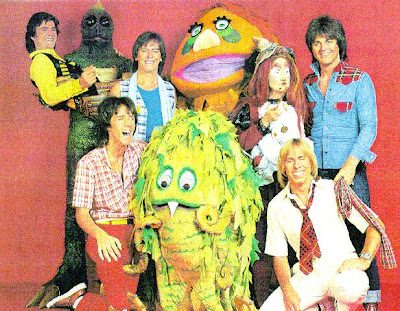
Speaking of The Bay City Rollers, they also wound up with a weekly TV series, although their came after their hit-making career had stopped.  One of the writers on that show was Mark Evanier.

"I worked on the show with The Bay City Rollers, Krofft Superstar Hour," Evanier says.  "There were two [different] shows:  there was The Krofft Supershow on ABC, which had Kaptain Kool and the Kongs [as] the hosts, and then we did Krofft Superstar Hour on NBC, which had The Bay City Rollers.  That show was later re-titled The Bay City Rollers show.

"That was a case where we had ABBA signed to do the show.  At the last minute ABBA pulled out, and The Bay City Rollers were substituted at the last minute.  The Bay City Rollers had actually dissolved the group; they put it back together because a couple of them needed money.  So they took the offer and came over and did the show.  And I think they dissolved the group right after that again."

(Note:  lead singer Les McKeown did indeed leave The Bay City Rollers after the TV show ended.  The remaining members--Alan Longmuir, Derek Longmuir, Stuart "Woody" Woods, and Eric Faulkner--recruited a new lead singer, Duncan Faure, and recorded a few little-heard [but pretty damned good!] albums under the truncated name The Rollers before finally folding in the mid-'80s.)
                 http://ecx.images-amazon.com/images/I/51ovFqnQmbL.jpg

Another genre with connections to bubblegum was disco.  "Disco was actually another bubblegum outgrowth," Bill Pitzonka agrees, "because that's where all the producers went. Neil Bogart [who'd left Buddah to form Casablanca Records, probably the preeminent disco label] was a marketing genius. In fact, [superstar Eurodisco producer] Giorgio Moroder used to put out these bubblegum singles out of Germany, with titles like “Looky Looky” and “Moody Trudy” and stuff like that, and they're these infectious little pop tunes that all sound like “Papa Oom Mow Mow.” Which actually leads us back to [bubblegum]. Because, you know, “Papa Oom Mow Mow,” “Wooly Bully,” these onomatopoeic things, had a real base appeal. And that's what bubblegum tapped into."

It is not a huge jump from The Archies or The Banana Splits to a prepackaged disco act like The Village People, who recorded for Bogart's Casablanca. Another Casablanca act with bubblegum roots was KISS, whose outlandish costumes and merchandising efficacy—not to mention their punchy, spunky singles, which drew inspiration from pop-rock as often as they did from hard rock—made them the kind of act Kasenetz and Katz would have killed for.


And then there's punk. Though the anger 'n' anarchy clatter of early punk was what got all the attention, punk also placed a premium value on concise ditties with immediate, visceral appeal.
"The punk movement was about breaking down barriers," notes Pitzonka, "and basically breaking through that whole art-rock thing that was going on. But also, once they got over the rage, once they actually learned how to play, no movement can go along without melody for long."

Punk acts like The Undertones, Generation X, The Rezillos and—especially!—The Ramones all drew readily-apparent inspiration from bubblegum. The Ramones actually covered both “Indian Giver” and “Little Bit O’ Soul” on record, and even the seemingly humorless Talking Heads used to cover “1-2-3 Red Light” live. At one point, Bomp! magazine openly wondered when The Ramones would get around to covering an Ohio Express tune; one regrets that they never did.

"It's just a dark edge," Ron Dante notes of punk's similarity to bubblegum.  "They had a dark edge to it.  But musically it's very close.  I always thought musically it was very close.  It was that band sound, formula type of song, that kind of predictable but fun [approach].  Their themes were a little darker, that's all.  You're right, there was a definite connection.  Nobody in that area is gonna admit it," Dante concludes with a laugh.

Don't be too sure about that, Ron.  As legendary Ramones guitarist told Goldmine in 1994, "We started off, and I think we wanted to be a bubblegum group.  At one point, The Bay City Rollers were becoming popular.  They had written 'Saturday Night' and then we sat down and said, 'We have to write a song with a chant in it, like they have.'  So we wrote 'Blitkrieg Bop.'  Somehow, in our warped minds, I think we thought we were a bubblegum group."

NEXT:  Sticky Residue:  Bubblegum's Legacy

 https://thecuriousastronomer.files.wordpress.com/2014/12/rmn_blitzkrieg-bop_f-up.jpg

Thursday, April 21, 2016

An informal History Of Bubblegum Music, Part 6

Continuing my history of bubblegum music, originally published in the April 25, 1997 issue of Goldmine.  It was subsequently edited for an appearance in the book Bubblegum Music Is The Naked Truth, partially for length and style, but also to avoid duplication with subjects discussed elsewhere in the book.  Writer Gary Pig Gold and I revamped my original article's section on The Monkees into an amusing debate on whether or not The Monkees were every really a bubblegum group.  Except for some minor editing, this restores the original, full-length piece as it appeared in Goldmine.  You can catch up with PART 1 PART 2 PART 3 PART 4 and PART 5
 

                                       http://images.wolfgangsvault.com/life-is-a-rock-but-the-radio-rolled-me/book/memorabilia/ZZZ020456-BK.jpg

(Wait For It) The Bubble Bursts

"I think bubblegum itself," Bill Pitzonka says, "the ending point can be pretty clearly cut off around 1971, '72. I like to cut it off right at the point where Dawn became a real act. Where all of a sudden this band that was making these pop singles and was just supposed to be this singles factory, you know,  became a real band and had a real identity.

"The whole thing about bubblegum is it's kind of faceless. And that is a good thing and a bad thing, because I don't know a lot of people who go around knowing the names of the members of The Ohio Express," Pitzonka notes, laughing. "That wasn't the point."

Although one can say accurately that bubblegum never really went away, its golden era had clearly passed by the early '70s.

"I think bubblegum had no place to go around '72, "Pitzonka says. "I mean, you could only work so much mileage out of a band that didn't exist. Unless you're like The Alan Parsons Project, which is a completely different animal. You can't make a career out of singles; hard as you try, you just can't. Even back then, you could have ten hit singles, but then it just dries up—there's nowhere to go.

"I think the genre pretty much dictated its own course. Kasenetz and Katz stopped hitting the charts as of the '70s. Then Bell (the label that inherited The Monkees' label, Colgems) took over—Bell was big. And that was the stuff like Tony Macauley, who also did “Love Grows (Where My Rosemary Goes).” That's when you also had Dawn and you had The Partridge Family. Davy Jones recorded for Bell.

"I've got the Bell singles listing. And it's funny, because until The Partridge Family, Bell had never had a gold album. All of a sudden, once they had a gold album, they had money. And you notice their singles release schedule goes from 20 singles a year to 40 singles a year to 70 singles a year to 90 singles a year to then, their last year of operation they had something like 125 singles. Now, in the process of doing 125 singles, and a lot of these were studio things--they'd hire producers to concoct bands for them. They didn't have any albums. They put out ten albums a year to 100 singles. That's kind of an example of how bubblegum was progressing and couldn't really pay for itself."

Kasenetz and Katz, for their part, attempted to move on past bubblegum.

"You know," they say, "a lot of people don't even know that we were involved with a lot of other artists and things; like 10cc, before they were 10cc, were doing a lot of things for us also [specifically, as a post-"Gimme Gimme Good Lovin'" incarnation of Crazy Elephant].  That was Graham Gouldman, [Kevin] Godley, [Lol] Creme, [Eric] Stewart.  We were involved with Bobby Bloom, who had the 'Montego Bay.'  We did Bo Diddley, not that it was successful, but we recorded a lot of other people.  You know, there's a whole lot of things that a lot of people don't remember.
                                         http://streamd.hitparade.ch/cdimages/bo_diddley-bo_diddley_1969_s.jpg
"And even like The Music Explosion, 'Little Bit O' Soul,' which I never thought was a bubblegum thing, people still refer to that at times as, 'That was a bubblegum type of thing.' and I said, 'Bubblegum?'  That really wasn't bubblegum, that was lik a lot of other things.  But I think it was because of us--if we put our name on it, everybody said, 'Oh, it's another bubblegum thing,' whether it was or wasn't.

"We were good to most of our people," say Kasenetz and Katz.  "We used to send them on trips and get 'em pianos as bonuses and this and that.  Because we had to keep them pepped up so that we could keep everything going.  And then that was it.  The groups had changed, and I think at the time that they were all burned out on the type of songs or whatever it was.  And that was it, and then we went on to other things.  We had a hit with the Ram Jam group with Bill [Bartlett], who was originally in The Lemon Pipers."  Ram Jam's cover of Leadbelly's "Black Betty" was a # 18 hit in 1978.
                      https://upload.wikimedia.org/wikipedia/en/d/d6/Black_Betty_Ram_Jam.jpg

Joey Levine also moved on.  "I did a bunch of work with this record company," he says, "and some things happened, but then we had fallen into a situation of...I don't know, it was over.  So what happened was I kind of sat out for a while.  I just sat down and just did some songwriting and thinking.  I was doing some songwriting, and some people recorded a couple of things.  You know, I had songs recorded, James Taylor recorded something ["Ain't No Song," co-written by Levine and David Spinozza], a little later on Bonnie Raitt ["I Got Plenty," co-written with Jim Carroll].  And I was getting records, but I stopped for a while.  And then I started doing commercials."

As noted before, Ron Dante refers to Levine as the biggest jingle producer in New York.

"Um, probably in the world," Levine corrects with a laugh.  "I probably have been at it longer and more successful than anybody."

Levine did return to the charts one more time in 1974, as the lead singer on "Life Is A Rock (But The Radio Rolled Me)," a # 8 hit for a studio group (of course!) called Reunion.

"Reunion's an old friend of mine," says Levine, "who I hadn't seen in a while.  I had been writing with this guy Mark Bellack [co-author of "Try It," by The Standells and Ohio Express] a little up at Aaron Schroeder's office.  And Mark wasn't really a great writer, but he was a good friend of mine and we worked on a couple of things.  And up at Schroeder, at a certain point they wanted to sign me, which I didn't wanna be signed.  So I said, 'But you should sign Mark.  Because if Mark is here, I'll write here,' you know?  But then when the contract came up, I said to Mark, 'Listn, don't renew your contract, 'cause I'm not writing over there any more.'  And he renewed it!  And I got a little peeved, I said, 'Mark, I told you not to renew it.'  And he said,'Well, I'm gonna write with some other guys, I think I got the handle.'

"So we didn't talk to each other for about...not aggressively, but we didn't see each other for about two years.  And then he came to me with that song, and he was cutting it and he said somebody was interested.  But I listened and I listened and I said, 'I like the song a lot,' I said, 'I think you're production's no good.  And I'm not trying to weasel in, but if you wouldn't mind, let me go and cut it.'

"And we re-cut the record, and I fixed up some of the lyrics and stuff, and it became a Top 10 record."

Ron Dante, now free of any compelling reason to remain an anonymous voice, returned to recording under his own name.

                          http://www.recordsbymail.com/uploads/6-28-15-1/224012-2.jpg

"I had a record called Ron Dante Brings You Up," he recalls,"and 'Let Me Bring You Up' was a Jeff Barry/Andy Kim song, and I thought it was a smash.  And [it[ just did not happen big across the country.  But it was a really good record, 'Let Me Bring You Up.'  And it was kind of The Archies meet some of those 'Happy Together' type of groups.  It was a pretty damn good record.  I always liked that record and song.  So it was kind of close--it wasn't as bouncy as the other stuff.  I wrote a bunch of stuff for the album.  I wanted to write a bunch of stuff, so I wrote a lot of the album."

During this period, Dante also recorded a single for Bell, "Don't Call It Love," under the name Bo Cooper.  He also returned to doing commercials, and it was in that field that he met a songwriter named Barry Manilow.  Dante went on to produce Manilow's first hit, "Mandy," and continued to co-produce Manilow's records until 1980.  Manilow, in turn, produced Dante's own (aughh!) disco remake of "Sugar, Sugar" in the mid-'70s.

Today, Dante remains proud of The Archies.  "Just two years ago," he says, "I did a cerebral palsy benefit type of thing where I went to the Hard Rocks and visited and performed for a special occasion to raise money for the Oreida Tater Tots.  Oreida put The Archies on their Tater Tots, and every bag you bought a few cents went to [fight] cerebral palsy.  And the Archie publication went into conjunction with that.  So I actually did the Hard Rocks last year, a year and a half ago.  And then I did The Greek Theater last October as The Archies, a special favor.  You know, I don't do it a lot because The Archies are owned lock, stock and barrel by the Archie comic book people.

Which is why Dante is interested in working out a deal with Archie's publisher to create a new Archies project.

"They're very protective of their copyright," he says.  "And they have other projects going, a Broadway show, a TV movie or a movie, a TV series, that are all potentially in development.  And they have signed deals with these people.  So I wanted the record rights to The Archies, and I negotiated with them for six months, because they wanted to see what the Broadway show did or what the TV show did.  So I understand their hesitancy.  But I think eventually I will end up with th right to the Archies recording group, and I will do a '90s version."

Dante goes on to describe his vision of the new Archies.  "In The Archies, the original group, the male lead voice was the strong lead voice and carried it.  In the '90s, I would use the female voices of Betty and Veronica.  The '90s would be more current.  Jughead might get an album out of it, you know, because he looks like a grunge rocker.  He could be a garage-band type of sound, with Jughead playing drums, have maybe a funny lead sound.

http://infinitecomix.com/wp-content/uploads/2015/08/Screenshot-3-e1440121906288.png
Reggie, Archie, and Jughead in 2016
"So there's many ways to do it.  The danceability of the records are important, and the fun, up, positive nature of it, because it does appeal to a younger market, I think, it does appeal to a pre-teen, teen [market].  But it's not hard-edge, if you know what I mean.  The average readership of an Archie comic is age seven to 13 girls, about 70 percent girls.  And it's very popular with that kind of innocent age too, that kind of not-yet-hip teenager," he says with a laugh, "still some babysitting jobs and things.  Some clean, wholesome music I think is necessary for popular music to be balanced.  If we have all one thing, as you know, it becomes very boring."

And, a few years ago, a clip of a whole group of Ron Dantes singing "Sugar, Sugar" began airing occasionally on VH1.

"When I was on tour as a solo artist in the 1970s," Dante recalls, "I went to Cleveland and did a show called Upbeat.  And I think Upbeat decided to tape me five or six times, singing 'Sugar, Sugar,' playing different instruments.  I think that's where I did it, I think I did it in Cleveland.  I know I was on tour for about six months, visiting all the major cities and doing all the local TV shows.  And I think I might have done that in Cleveland.  I was as surprised as anybody when [VH1] started to play it," he notes with a laugh.  "I had forgotten all about it."

Over two decades after the cartoon Archies appeared on The Ed Sullivan Show, TV viewers finally had a chance to match the face with the voice of "Sugar, Sugar."

NEXT:  Cleaning Up This Gooey Mess

 http://2.bp.blogspot.com/_D1ZZyTOG7tQ/TGLPuQl4GCI/AAAAAAAAHoQ/dB1y7en0SEM/s400/The+Krofft+Superstar+Hour+with+the+Bay+City+Rollers.jpg