Showing posts with label DC Comics Before The Crisis. Show all posts

Wednesday, January 3, 2024

DC COMICS BEFORE THE CRISIS: Heroes Of Earth-One AND Earth-Two, Part 3 of 3


Concluding our three-part look back at DC Comics before the multiverse-ending Crisis On Infinite Earths, recalling Earth-Two heroes with identical Earth-One counterparts in the Silver and Bronze Ages. You can catch up with Part 1, then Part 2, and follow along now as we continue with some more heroes of two worlds.

THE SPECTRE

The Spectre was created by Superman's co-creator Jerry Siegel, and the Spectre was far, far and away the more physically powerful of the two. Given that the Spectre--the vengeful ghost of murdered police detective Jim Corrigan--has often been portrayed as a near-omnipotent figure, it's possible we should consider him a resident of the entire freakin' multiverse. Especially when the Spectre, like, grows to superplanetary size. Big guy, that Spectre.

But in the '40s, the Spectre was a founding member of the Justice Society of America. His 1960s solo series was presumed to be set on Earth-Two--a mention of the JSA in The Spectre # 3 confirmed that presumption--and even his first Brave And Bold co-starring guest spot commenced with the Earth-One Flash adventurin' on Earth-Two and deciding to pop in and visit his old buddy the Spectre while he was there. That's...an unusual bro combo. But yeah, the Spectre is considered an Earth-Two character.

I say there was also an Earth-One Spectre. I don't have an awful lot of evidence to support that claim. Most of the Spectre's subsequent Brave And Bold appearances with Batman are ruled irrelevant and inadmissible, given B & B writer Bob Haney's willful disregard for comic book continuity. Nor does the Spectre's 1970s series in Adventure Comics pin the Ghostly Guardian to any particular Earth; offhand comments by a couple of characters in one issue of Adventure implied common public knowledge that Clark Kent was Superman, which would rule out events taking place on either Earth-One or Earth-Two.

That said, Batman and the Spectre co-starred one more time, in 1983's The Brave And The Bold # 199, the next-to-last issue of that series. "The Body-Napping Of Jim Corrigan" wasn't Haney's work, but was instead written by Mike W. Barr, and it feels like it's set on Earth-One.


Slightly more conclusive evidence is offered by 1981's DC Comics Presents # 29, as the Spectre wrassles with Superman on the cosmic plane. One could counter that this issue supports the idea of the Spectre being a multiversal character not tied to a single Earth, and one would probably be right, I guess. But I dunno. I think DC Comics Presents # 29 and The Brave And The Bold # 199 show us the Earth-One Spectre. 

Hell, I'm even gonna move those Adventure Comics stories to Earth-One, too. They depict a Spectre more vicious and vengeful than he'd been since his earliest '40s strips; I think the Earth-Two Spectre moved past his original bloodthirstiness, while this Earth-One Spectre was still in his active eye-for-an-eye stage.

And the Clark Kent is Superman thing? Maybe an Earth-One tabloid suggested this preposterous notion that the Man of Steel was secretly a mild-manner reporter for a great metropolitan newspaper. Kinda like tabloid reports that Elvis Presley is alive and pumpin' gas in Tucson, or Debbie Gibson is pregnant with a two-headed love child.

Clark Kent? Superman..?!

Heh. As if!

STEEL THE INDESTRUCTIBLE MAN

Steel the Indestructible Man was a 1940s-set hero introduced in 1978, the star of his own title. The character was created by writer Gerry Conway and underrated artist Don Heck. Steel The Indestructible Man only lasted five issues before its cancellation, and I have no recollection if Steel's adventures were designated as occurring on Earth-One, Earth-Two, or an Earth to be named later. Earth-One appeared to be the default answer when Conway had Steel's grandson (also called Steel) join the Justice League in 1984. Roy Thomas also used Steel in All-Star Squadron, creating TWO default answers.

THE VIGILANTE

Modern-day masked cowboy hero the Vigilante was among DC's more resilient Golden Age back-up characters. Never a lead feature, Vig still had sufficient vigor to survive into the '50s, to star in his own movie serial, and to be a member of DC's second group of costumed crimebusters the Seven Soldiers of Victory.

In 1972, Justice League Of America # 100 established that the Seven Soldiers of Victory operated on Earth-Two. As a solo hero, the Vigilante's relative durability into the '50s meant he was around long enough for writer Steve Englehart to include Vig alongside other '50s heroes (like Blackhawk, Plastic Man, Robotman, Congo Bill, the Challengers of the Unknown, and Rex the Wonder Dog) in a flashback to the untold origin of the Justice League in 1977's JLA # 144.

But the Vigilante's presence on Earth-One was made canon well before that. In 1970, a two-part story in JLA # 78-79 showed the Vigilante fighting alongside the JLA. The Vigilante's latter-day solo stories in '70s issues of Adventure Comics and World's Finest Comics would seem to have occurred on Earth-One. 

The Earth-One Vigilante also had a nephew, Michael Carter, who protected the citizens of  Houston as the masked crimefighter Swashbuckler. Swashbuckler teamed with Batman to take on the Riddler in 1980's Detective Comics # 493.

WILDCAT

Wildcat was a backup to Wonder Woman's lead feature for the first 90 issues of Sensation Comics, 1940 to 1949. Wildcat was considered a member of the Justice Society, based on his two 1940s appearances with the JSA in All Star Comics. When the JSA was revived in the '60s, Wildcat became a frequent fixture in the annual JLA/JSA team-ups.

He also became a recurring team-up partner for Batman in The Brave And The Bold. Again, that wouldn't necessarily prove an Earth-One Wildcat, since we presume most of Bob Haney's B & B and other work for editor Murray Boltinoff took place on the out-of-continuity Earth-B (for Boltinoff.)

BUT...!

Wildcat also appeared with the Creeper (certainly an Earth-One guy) in 1975's Super-Team Family # 2. This story was written by Denny O'Neil, and while there's no reason to swear it's canon, there's also no overriding edict that it ain't. Book it. Earth-One Wildcat.

ZATARA

Wonder of wonder, miracle of miracles? No--TRADITION! The early days of comics built a tradition of crime-fightin' magicians, the vast majority of 'em patterned after/stolen from the successful newspaper comic strip Mandrake The Magician. Though that was the model, my experience with ol' Mandrake is limited, and I don't know if he actually had magic powers or if he was an extra-resourceful stage magician really, really good at gesturing hypnotically

Zatara debuted in Action Comics # 1 in 1939, a comic book I'm told has some important historical significance. John Zatara was a direct copy of Mandrake, adding the wrinkle of doin' that voodoo that he do so well via speaking his magical commands backward: YEH! Erongi taht Namrepus yug pu tnorf dna yap noitnetta ot EM, ref 'niyrc tuo duol! 

Zatara was not a star in the Golden Age, and his only specific labeling as an Earth-Two hero is in All-Star Squadron. His highest level of recognition is as the father of Zatanna. Zatanna was introduced in the '60s, as she enlisted members of the Justice League to help her find and rescue her missing papa. Zatanna later joined the JLA, and she and that version of her dad are recognized as Earth-One people.

That's our list of identical heroes who existed on both Earth-One and Earth-Two. As a tangent, here are a couple of Earth-Two characters who relocated to Earth-One:

THE BLACK CANARY

A clunky retcon in the '80s changed this one, but we should still mention Black Canary in the context of what had been canon until then. Black Canary (alias Dinah Drake) debuted in Flash Comics # 86 in 1947, introduced as a presumed bad-girl foe for Justice Society member Johnny Thunder and his Thunderbolt. She turned out to be an undercover hero, but she was still just evil enough to eventually take Johnny's place in the JSA.

Black Canary was a frequent participant in JLA/JSA team-ups in the '60s. In between her final Golden Age appearances and her return in the Silver Age, Black Canary married her 1940s love interest, Detective Larry Lance. During the course of the 1969 JLA/JSA crossover, Lance gave his life to save his beloved Dinah. Grief-stricken, Black Canary switched universes and became a member of the Justice League on Earth-One.

The '80s retcon claimed that the original Black Canary didn't make it to Earth-One, succumbing  to mortal injuries inflicted during the battle that killed her husband. Her now-adult daughter emerged from a cosmic coma, became the new Black Canary, and joined the JLA. The new Black Canary had no memory of her own early life, and believed she was, yes, her own mother.

Yechh.

THE RED TORNADO


There were Golden Age and Silver Age characters called the Red Tornado, and they definitely were not identical. The original Red Tornado was a tough, brawny matron named Ma Hunkel, who donned a costume to beat up various gangsters and nogoodniks who tried--and FAILED!--to terrorize Hunkel's poor but honest urban neighborhood. She was a supporting character in Sheldon Mayer's humor strip Scribbly, and she made a one-page appearance in All Star Comics # 3, the Justice Society's 1940 debut. The Scribbly and Red Tornado stories I've read were great comics. In the extremely unlikely event I ever had an opportunity to write the JSA's adventures, you can be damned sure the Golden Age Red Tornado would be included.

The Silver Age Red Tornado was introduced in 1968, a super-powered android originally implanted with false memory that he actually was Ma Hunkel, attempting to rejoin the Justice Society. This new Red Tornado was created by the sinister T.O. Morrow to destroy Earth-Two's JSA as a practice run for destroying Morrow's real enemies, the JLA over on Earth-One. Unfortunately for Morrow, Reddy don't play that, and he wound up joining the Society.

The newer Red Tornado was destroyed in the act of saving the universe in Justice League Of America # 102, the 1971 JLA/JSA event that revived the Seven Soldiers of Victory. His android form was subsequently reconstituted on Earth-One, and he joined the Justice League.

SARGON THE SORCERER

Among the legion of comic-book magicmakers, at least Sargon the Sorcerer--like Fawcett ComicsIbis the Invincible--didn't copy Mandrake's look. Instead of a tuxedo, moustache, and top hat, Sargon and Ibis complemented their formal attire with turbans and clean-shaven faces. Ibis the Invincible wielded the power of his Ibistick, and Sargon had the magical Ruby of Life affixed to his chapeau. Ibis was (by far) the more successful of the two, supplementing his initial post as back-up to Captain Marvel in Whiz Comics with his own solo series. Sargon was only ever a back-up.

Sargon was revived in the late '60s as an antagonist for the Earth-One Flash, and he later helped the JLA battle Starbreaker in the early '70s.

Other than a 1944 cover appearance on The Big All-American Comic Book alongside JSA members the Atom, the Flash, Green Lantern, Hawkman, Johnny Thunder, Wildcat, and Wonder Woman, nothing originally connected Sargon the Sorcerer to Earth-Two in particular (beyond the presumption that all DC characters of the '40s were probably on Earth-Two). All-Star Squadron made that canon.

And apparently, at some point in some Silver or Bronze Age comic book, Sargon himself said something to the effect that he had moved from Earth-Two to Earth-One. 

Because c'mon: Who needs two Sargons, right?

If you like what you see here on Boppin' (Like The Hip Folks Do), please consider a visit to CC's Tip Jar

Carl's new book Gabba Gabba Hey! A Conversation With The Ramones is now available, courtesy of the good folks at Rare Bird Books. Gabba Gabba YAY!! https://rarebirdlit.com/gabba-gabba-hey-a-conversation-with-the-ramones-by-carl-cafarelli/

If it's true that one book leads to another, my next book will be The Greatest Record Ever Made! (Volume 1). Stay tuned. Your turn is coming.

This Is Rock 'n' Roll Radio with Dana & Carl airs Sunday nights from 9 to Midnight Eastern, on the air in Syracuse at SPARK! WSPJ 103.3 and 93.7 FM, streaming at SPARK stream and on the Radio Garden app as WESTCOTT RADIO. Recent shows are archived at Westcott Radio. You can read about our history here.

I'm on Twitter @CafarelliCarl

Friday, December 29, 2023

DC COMICS BEFORE THE CRISIS: Heroes Of Earth-One AND Earth-Two, Part 2 of 3


Today we have the second of three parts looking back on DC Comics before the multiverse-ending Crisis On Infinite Earths, recalling Earth-Two heroes with identical Earth-One counterparts in the Silver and Bronze Ages. You can catch up with Part 1, and follow along now as we continue with some more heroes of two worlds.

AIR WAVE

In the '70s, DC billed itself as "The Line Of Super-Stars." Air Wave (alias Larry Jordan) was never a super-star, not in any incarnation. During the Golden Age, Air Wave was a backup strip in Detective Comics, and I doubt he ever appeared on a single comic book cover in the '40s.

Flash forward to 1981, when Wikipedia sez a backup story in DC Comics Presents # 40 told us that Air Wave had been killed in action, replaced briefly by his wife Helen, who avenged his death (and promptly retired from caped crusading). 

Because shared surnames are never a coincidence in comic books--I think it's a law or something--we later learned that Larry Jordan was related to Hal Jordan, Earth-One's Green Lantern. Larry and Helen's son Harold Jordan became a new Air Wave, appearing in a new series of backups in Action Comics. Young Harold backed up Superman in Action, just as his father had backed up Batman in Detective.

The family connection to Hal Jordan/Green Lantern establishes Air Wave as an Earth-One character. Air Wave never had any contact with other characters during the Golden Age, so we wouldn't necessarily have to presume there ever was an Earth-Two Air Wave.

Or we wouldn't have had to make that presumption until the '80s, when the All-Star Squadron series--which was clearly and specifically set on Earth-Two--included the original Air Wave among its sprawling roster.

BATWOMAN AND BATGIRL

In a reversal of our usual understanding of which characters inhabited which Earth, the distaff Dynamic Duo of the original Batwoman and Batgirl would have been considered Earth-One characters. Kathy Kane and her niece Betty Kane were effectively banished from Batman's adventures when editor Julius Schwartz instituted Batman's New Look in 1964, but they were part of Gotham City continuity contemporary to the debut of the Justice League, and they eventually returned in Bronze Age stories in Detective Comics and Teen Titans

(And I actively despised Detective Comics # 485, the issue where Batwoman was killed off. I still despise it.)

Batwoman and this original, pre-Barbara Gordon Batgirl could have been solely Earth-One characters, but they were eventually referenced in an Earth-Two context, in a couple of early '80s issues of The Brave And The Bold written by Alan BrennertB&B isn't always a reliable resource for continuity, but that's mostly because editor Murray Boltinoff and regular writer Bob Haney thought the very idea of such continuity was too cumbersome and unnecessary. These two Brennert issues (# 182 and 197) are canon in my view.

THE BLACKHAWKS

With Blackhawk and his intrepid squad, we have a set of characters who--like Aquaman, Batman and Robin, Green Arrow, Superman, and Wonder Woman--remained in print from the Golden Age into the Silver Age. Blackhawk's exploits were originally published by Quality Comics in the '40s and '50s, and continued thereafter when Quality exited the comics biz and DC bought out a number of Quality properties. 

The Blackhawks didn't interact much with the rest of the DC Universe in the '60s, but the few connections that did occur suggested they were inhabitants of Earth-One. The connection was made definite in Justice League Of America # 144 in 1977, which flashes back to a previously-untold adventure from the 1950s, and shows us the Blackhawks alongside the Earth-One heroes who would form the Justice League.

(We'll be coming back to that issue of JLA a few more times before we're done here.)

Given that Blackhawk wasn't published by DC in the '40s, there isn't necessarily any reason to tie that intrepid squadron to events on Earth-Two. In 1973, Justice League Of America # 107 revealed that there had been a (presumably identical) version of the Blackhawks on a newly-revealed Earth designated Earth-X. Earth-X was the home of other Quality characters--Black Condor, Doll Man, Human Bomb, Phantom Lady, the Ray, and Uncle Sam--as well as Blackhawk. 1980s issues of All-Star Squadron established that these Earth-X heroes had all originated on Earth-Two.

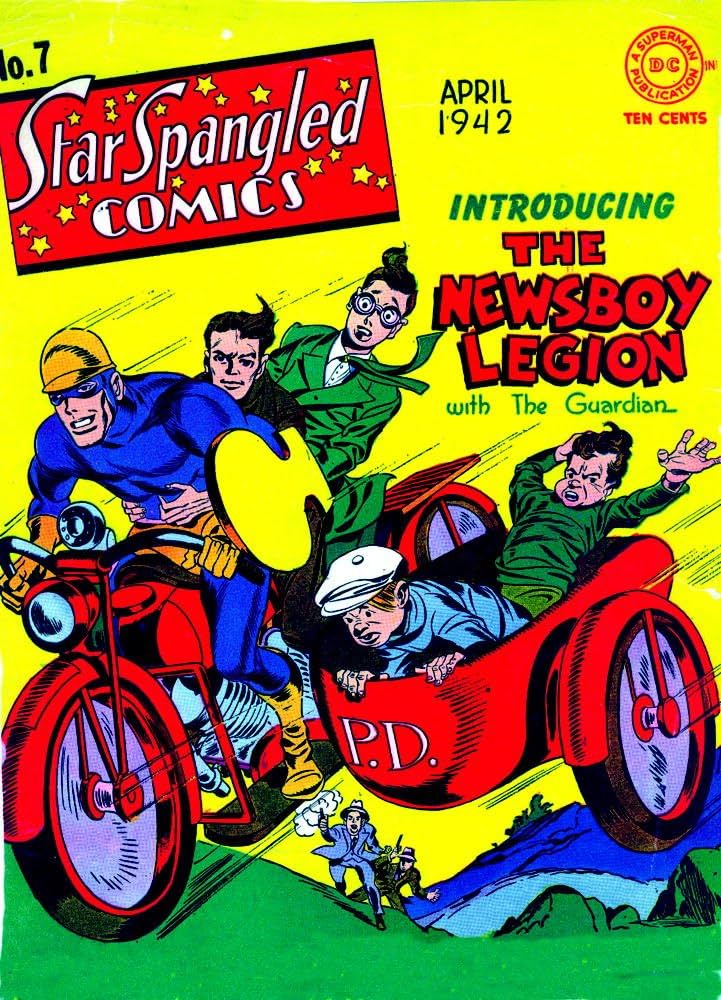
THE GUARDIAN AND THE NEWSBOY LEGION

A new version of Joe Simon and Jack Kirby's 1940s kid gang the Newsboy Legion was introduced when Kirby took over Superman's Pal Jimmy Olsen in 1970. I absolutely loved Kirby's run on this book at the time, and I may love it even more now.

This new Newsboy Legion debuted in JO # 133--Kirby's first issue on the title--were the sons of the originals and went by the same names: Big Words, Gabby, Scrapper, and Tommy, plus new addition Flippa Dippa. The fathers also appeared in Kirby's run, as did a new version of the first group's costumed protector the Guardian, a clone of the slain original from the '40s.

During the Golden Age, the adventures of the Guardian and the Newsboy Legion were published in Star-Spangled Comics. They also appeared in a Boy Commando story in Detective Comics # 76, a story which also included Sandman from Earth-Two's Justice Society of AmericaAll-Star Squadron subsequently reinforced the Newsboy Legion's status as residents of Earth-Two, with identical counterparts on Earth-One.

MANHUNTER

Simon and Kirby were also the principal auteurs of the Golden Age Manhunter, whose '40s adventures appeared in (of course) Adventure Comics. Simon and Kirby were also responsible for Sandman (and Sandy the Golden Boy) in Adventure; both strips predate Simon and Kirby's involvement, though the pre-S & K Manhunter was non-costumed and shared only a name with our more familiar Manhunter. After the initial S & K Manhunter strip in Adventure Comics # 73 introduced the character (secretly big game hunter Rick Nelson), the civilian name was changed to the pre-S & K Paul Kirk in all later appearances. Rick Nelson presumably abandoned crimefighting, and went to a garden party to reminisce with his old friends.

Manhunter appeared with Sandman and Sandy on the cover of Adventure Comics # 78. Maybe we shouldn't necessarily consider a comic book cover as an indication of canon, but once again the '80s All-Star Squadron definitively placed the Golden Age Manhunter on Earth-Two.

As for Manhunter's Earth-One bona fides, a brilliant 1970s Detective Comics backup strip by Archie Goodwin and Walt Simonson starred Manhunter, Paul Kirk, revived and enhanced but still the same guy who kicked ass back in the '40s. In his farewell in Detective Comics # 443, Manhunter teamed with the book's star character, the Earth-One Batman. A clone of Paul Kirk later appeared in The Secret Society Of Super-Villains.

PLASTIC MAN

Like Blackhawk, Plastic Man is a character that DC acquired from Quality Comics. Unlike Blackhawk, DC didn't get around to using Plas until 1966, and the Silver Age Plastic Man was eventually revealed to be the son of Eel O'Brien, the Golden Age Plastic Man. This Silver Age Son of Plas was never really mentioned outside of his book's ten-issue run. (This run was my introduction to Plastic Man, and I talk about that history here.)

The '60s Plastic Man pretty much lived in a pliable world of his own, though he did team with Batman in a 1968 issue of The Brave And The Bold (# 76). All of Plas' subsequent B & B guest spots used the Eel O'Brien original (or at least Bob Haney's interpretation of him).

Unlike Batwoman and the original Batgirl's appearances in The Brave And The Bold, we generally disregard (or at the very least regard with an asterisk) the continuity ramifications of whatever paces and paths Bob Haney and Murray Boltinoff ran for DC characters in B & B. These stories deliberately existed outside of continuity, indifferent to the larger DC Universe. Plastic Man's Brave And Bold c.v. does not establish Plas on Earth-One or Earth-Two, or anywhere other than the world of The Brave And The Bold. We call it Earth-B, for Boltinoff. B & B seeing you!

The only pre-Crisis evidence of Plastic Man on Earth-One is the same evidence we have for Blackhawk: Justice League Of America # 144. The Earth-Two Plastic Man is also proven the same way we prove the Earth-Two Blackhawk: a deceased Earth-X hero in JLA # 107, revealed to have originated on Earth-Two in All-Star Squadron.

(We should also mention Plastic Man's very first DC Comics appearance, albeit an appearance by proxy. In 1966's House Of Mystery # 160, Robby Reed used his Dial H For HERO device to turn into "Plastic Man--that famous crime-fighting hero of years ago!" Reed later appeared again in Plastic Man's Bronze Age series in the '70s. I don't know if Reed ever crossed over with any other Earth-One [or Earth-Two] heroes pre-Crisis.)

ROBOTMAN

The Golden Age Robotman was Robert Crane, a scientist mortally wounded but saved by having his brain placed in a new mechanical body. The Silver Age Robotman was Cliff Steele, a race car driver mortally wounded but saved by having his brain placed in a new mechanical body (and then becoming a founding member of the Doom Patrol). In each case, super-powered hijinks ensued. Similar origins notwithstanding, the two Robotmen were most definitely not the same character. 

The Robert Crane Robotman survived as a back-up feature into the 1950s, and I recall reading the occasional Robotman reprint when I was a kid in the '60s and early '70s. Ol' Robotman kinda kept to himself in the '40s and '50s, so we only have (once again!) Justice League Of America # 144 to place him on Earth-One, and All-Star Squadron (again and again) to tie him to Earth-Two.

We still have five more heroes to address. We'll get to them in Part 3, along with three characters who moved from Earth-Two to Earth-One.

If you like what you see here on Boppin' (Like The Hip Folks Do), please consider a visit to CC's Tip Jar

Carl's new book Gabba Gabba Hey! A Conversation With The Ramones is now available, courtesy of the good folks at Rare Bird Books. Gabba Gabba YAY!! https://rarebirdlit.com/gabba-gabba-hey-a-conversation-with-the-ramones-by-carl-cafarelli/

If it's true that one book leads to another, my next book will be The Greatest Record Ever Made! (Volume 1). Stay tuned. Your turn is coming.

This Is Rock 'n' Roll Radio with Dana & Carl airs Sunday nights from 9 to Midnight Eastern, on the air in Syracuse at SPARK! WSPJ 103.3 and 93.7 FM, streaming at SPARK stream and on the Radio Garden app as WESTCOTT RADIO. Recent shows are archived at Westcott Radio. You can read about our history here.

I'm on Twitter @CafarelliCarl