Collecting a four-part blog series from 2025

Seeking distraction from super-villain team-ups in the real world, I started thinking about the history of super-villains joining forces in the comics. As I said in the preamble to a recent short story I wrote, "Much of the pulp fiction of the 1930s and ‘40s was created in response to the crisis of the Depression and the horror of Fascism...Catharsis is no substitute for action. But it does serve a purpose."
I started my reminiscence with the first meeting of Superman's arch enemy Lex Luthor and Batman and Robin's foe the Joker (World's Finest Comics # 88, May-June 1957), even though I knew that certainly wasn't the first time previously-established nogoodniks formed a bad-guy pact in comics. At the very least, the Luthor-Joker alliance was predated by the 1944 teaming of the Joker and the Penguin in Batman # 25. And I was pretty sure that wasn't the first super-villain team-up either.
While I had no illusions of concocting a definitive timeline of super-villain team-ups, I was interested in slappin' together some general information on the history of such things. I presumed there weren't any precedents in 1930s newspaper strips; if it turns out two or more of Dick Tracy's previously-introduced adversaries formed an alliance prior to 1941, I will stand corrected.
Otherwise, 1941 seems a good starting point. A Google search for "first super-villain team-up" brought me to the GCG Comics chat forum, where a 2020 post suggested that the partnership of Dr. Fate's enemies Wotan and Karkull in More Fun Comics # 70 (August 1941) was comics' first-ever super-villain team-up.
I was initially resistant to this, figuring Daredevil Battles Hitler # 1 (also from 1941, published just a little before the above-cited issue of More Fun) had to be the first. But my memory of the Daredevil book led me astray; I thought the issue-long story involved Daredevil's opposite number the Claw working with other villains on behalf of the Third Reich, but I believe the Claw was the only comics super-villain enlisted here by real-life super-villain Adolf. Daredevil Battles Hitler doesn't qualify. Barring evidence to the contrary, I'm gonna go along with naming Wotan and Karkull as the first. And thank God Dr. Fate was there to stop them!
Where does the history of super-villain team-ups go from there? I have a Leading idea. We'll attempt to continue tracking that chronology of treacherous collusion in Part 2.
PART 2
The Justice Society of America was the first-ever super-team in comics, their inaugural meeting depicted in All-Star Comics # 3 (Winter 1940), predating Wotan and Karkull's super-villain team-up in '41. The JSA's debut wasn't the first instance of characters from different strips crossing over--the Human Torch and Sub-Mariner battled in Marvel Mystery Comics # 8 (June 1940), and my gut is that was the first such crossover, though I invite corrections--and nor did All-Star Comics gather any bad guys from its heroes' individual comic-book homes. I think our next super-villain team-up came one year later, as part of the origin of comics' second super-team, the Seven Soldiers of Victory.
Like the Justice Society, the adventures of the short-lived Seven Soldiers of Victory (aka Law's Legionnaires) were published under the DC Comics imprint, although there were actually two different publishers sharing the DC brand name: All-American Comics and Detective Comics. That may be an oversimplification of the complicated interrelationship between AA and DC, but we don't need to get too much into the weeds here.
The JSA was originally a mix of AA characters (like Green Lantern, the Flash, Hawkman) and DC characters (Dr. Fate, the Spectre, Hourman, honorary JSA members Superman and Batman), though the DC heroes would be phased out of the JSA over time, at least until DC absorbed AA a few years later. The Seven Soldiers of Victory were all DC guys: Green Arrow and Speedy, the Vigilante, the Shining Knight, Star-Spangled Kid and Stripesy, and the Crimson Avenger, with the Crimson Avenger's Asian stereotype sidekick Wing serving as the unofficial eighth Soldier.
The SSoV debuted in Leading Comics # 1 (Winter 1941), brought together to combat the evil machinations of the criminal mastermind the Hand, who had gathered a group of our heroes' own enemies--his five fingers--for, y'know...EVIL! The bad guys don't act as a group, as each hero faces his own adversary in separate chapters. But all of the villains are acting under the Hand's guidance, making this the second super-villain team-up and the first super-villain group.
It's worth noting that two of our assembled malevolent forces--the Vigilante's enemy the Dummy and the Crimson Avenger's opponent Big Caesar--had not appeared anywhere prior to Leading Comics # 1. But--no matter what!--the three other bad fingers the Needle, Professor Merlin, and Red Dragon had indeed already clashed with their respective foes Star-Spangled Kid and Stripesy, Green Arrow and Speedy, and the Shining Knight. Yeah, this one qualifies under my definition of a super-villain team-up.
You know what else qualifies as a super-villain team-up? Well! We'll talk about that worm and his monsters in Part 3.
PART 3

The original Captain Marvel's battle with "The Monster Society of Evil" was an epic with no precedent in the then-short history of comic books: A 25-part serial with the hero facing an army of organized bad guys. Some of the bad guys were the true-life villains the Allies were fighting contemporaneously in World War II. But most were comic-book adversaries, many of whom had appeared in previous battles with our hero. And all of these ne'er-do-wells took malevolent orders from a sinister worm called Mister Mind.

As "The Monster Society Of Evil" began, no one--not even writer Otto Binder--knew Mister Mind was a literal creepy, crawly worm from outer space. In the serial's first chapter in Captain Marvel Adventures # 22 (March 1943), a voice from the stars introduces himself as Mister Mind, and sets his minion (and familiar Captain Marvel foe) Captain Nazi to carry out his evil plan. What plan? For EVIL, of course! The initial burst of evil involves the theft of a magic pearl, with powers Mister Mind wants out of the Allies' reach and in the hands of the Axis (the real-life Monster Society of Evil). The good guy Captain defeats the Aryan Captain, but Mr. Mind calls in reinforcements including Captain Marvel enemies Dr. Sivana, Ibac, Nippo, and Mr. Banjo, plus a still-fighting Captain Nazi. Captain Nazi is captured, but Ibac escapes with the magic pearl. Victory in the first round of this battle goes to Mister Mind and his Society.

The splash page for this first chapter indicates the source of inspiration for this comics serial. The success of the 1941 twelve-chapter movie serial The Adventures Of Captain Marvel nudged Fawcett Comics (Cap's publisher) toward the idea of an extended storyline to keep the kids coming back for more. During World War II, Captain Marvel was one of the best-selling superheroes in comics. With one magic word--SHAZAM!-- young Billy Batson was transformed into the mighty Captain Marvel, whose popularity rivaled and even surpassed that of DC Comics' standard bearer Superman. That didn't sit well with the folks at DC, who spent years trying to litigate Cap out of business, eventually prompting Fawcett to settle the suit and cancel its superhero line of comics. Decades later, DC wound up buying the Captain Marvel character outright, marketing him as Shazam in deference to other rival Marvel Comics swooping in to trademark the Captain Marvel name in the interim. The comics business is a business, kid.

The name of DC's early '40s swell bunch of guys the Justice Society Of America was likely an unconscious (or conscious) influence on Otto Binder when he concocted Mister Mind's swinish bunch of guys and called 'em the Monster Society of Evil. Reminiscences published in Steranko's History Of The Comics suggest that Binder had no preconceived notion of precisely what Mister Mind would be, and the idea of making the World's Mightiest Mortal's elusive and resourceful enemy an itty-bitty li'l worm occurred after the story was underway. But some chapters included occasional teaser glimpses of an unidentified worm--because, really, who goes around identifying worms?--before Mister Mind was revealed in Captain Marvel Adventures # 27 (September 1943). The serial concluded in Captain Marvel Adventures # 46 (May 1945), as Mister Mind was captured, tried, convicted, and executed for his crimes. Serves 'im right, the little worm.
Multi-part comic book serials are commonplace now, their eventual ubiquity jump-started in the '60s at Marvel. And there had certainly been to-be-continued comics stories before Mister Mind put his gang together. But it was a radical move for a comics publisher to attempt a 25-part comic book serial in the '40s, when funnybooks were absolutely considered ephemeral and disposable, a time when it certainly wasn't a given that the audience would remain invested, month after month, eager to trade their dimes again and again and again for the next exciting installment of an extended storyline.
That audience came back for Captain Marvel Adventures and "The Monster Society Of Evil." The power of SHAZAM!
After shining a spotlight on this epic multi-chapter super-villain team-up, HONOR AMONG THIEVES will return to more familiar single-issue shenanigans in Part 4. Meanwhile, back in Gotham City....
PART 4
Before we continue, I need to acknowledge the fact that this brief history of super-villain team-ups has been focused on DC Comics. Part 3 dealt with Fawcett Comics' original Captain Marvel and the Monster Society of Evil, but even that former DC rival has long since been absorbed by DC. I have a feeling I might be missing some super-villain collaboration that took place in pages not associated with the house that Superman built, and I welcome additions. I know some of the Spirit's adversaries worked together at various points, though I don't know the time frame. Those stories first appeared in newspapers (in Will Eisner's weekly comics insert, alongside the individual exploits of Lady Luck and Mr. Mystic) rather than in comic books, but the Spirit's newspaper adventures were also reprinted in comic books.
Anyway, back to DC again, and what I think must be the first one-to-one alliance between A-list comic book bad guys, as the Joker meets the Penguin in "Knights Of Knavery" (Batman # 25, September-October 1944).
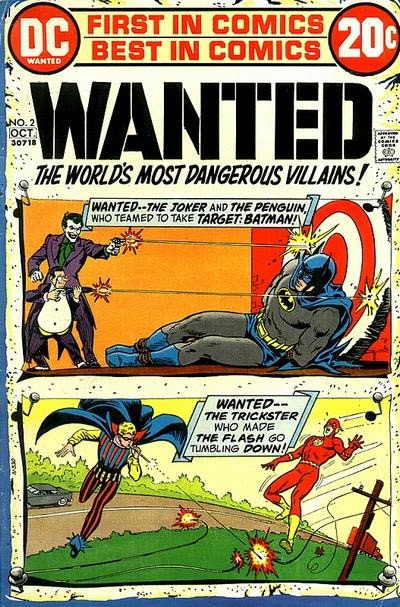

Comics crossovers are so common now, and a devil's pact between a couple of bad guys who share a common foe is such an obvious and promising notion for a story. By the time I read a reprint of "Knights Of Knavery" in 1972 (Wanted: The World's Most Dangerous Villains! # 2), the paths of the Joker and the Penguin (and/or the paths of many other Bat-villains) had already crossed on several occasions in the comics, and Joker and Penguin met on two separate occasions on screen, in the 1966 Batman feature film and in a three-part episode of the 1966-68 TV series. But in 1944, and with all apologies to Dr. Fate and his terrible twosome of Wotan and Karkull, teaming the Joker and Penguin was obvious in retrospect but groundbreaking at the time. It wasn't the epic spectacle of Captain Marvel facing and ultimately thwarting Mister Mind and his malevolent minions, but it was for damned sure enjoyable and even epic in its own right.

It would be too pat and presumptuous to say that "Knights Of Knavery" was where comic book super-villain team-ups began in earnest. Still, it's easy to dismiss the relative impact of the Dr. Fate and Seven Soldiers of Victory stories, and maybe--maybe--we can consider the Monster Society of Evil serial as something unique and nonpareil.
"Knights Of Knavery" feels different: It feels like a blueprint going forward. That feeling may be illusory, and it's likely that no subsequent writer held any conscious or unconscious thought of "Knights Of Knavery" when crafting some later gathering of two or more nogoodniks. But man, it feels like a watershed moment, even more so than Mister Mind's legion of doomsters.


So this is where we'll end our brief history of super-villain team-ups. There were many more to come before the Marvel Age Of Comics made 'em a regular part of your comics-reading diet. The Injustice Society (or Injustice Gang) challenging the Justice Society of America in All Star Comics # 37 (October-November 1947) and again in All Star Comics # 41 (1948), and Villainy, Incorporated facing the Amazon Princess in Wonder Woman # 28 (April 1948) were in the Monster Society mold. But through the 1950s and into the '60s, there were more small-group super-villain team-ups than there were sinister societies, and I say "Knights Of Knavery" set the template for most of those. Lex Luthor, the Toyman, and the Prankster. Luthor and Brainiac, and yeah, big bad bald bad Lex clearly got around a bit. Oh, and let's not forget the Joker and Clayface, and my favorite, the Joker and Luthor.

Hyper-speed takes over at this point. In the '70s, Marvel had a series called Super-Villain Team-Up, and DC had one called Secret Society Of Super-Villains. Hell, in 1976, that get-around guy Lex Luthor became the very first DC character to officially meet a Marvel character when he formed an alliance with Doctor Octopus in Superman Vs. The Amazing Spider-Man.
It's all a long, long way from Wotan and Karkull trying to gang up on Dr. Fate in 1941, right? But it had to start somewhere. Honor among thieves? No, at least not usually, and never for very long. But we honor the history. And we still thrill to the stories.
If you like what you see here on Boppin' (Like The Hip Folks Do), please consider a visit to CC's Tip Jar. You can also become a Boppin' booster on my Patreon page.
I compiled a various-artists tribute album called Make Something Happen! A Tribute To The Flashcubes, and it's pretty damned good; you can read about it here and order it here. My new book The Greatest Record Ever Made! (Volume 1) is now available, and you can order an autographed copy here. You can still get my previous book Gabba Gabba Hey! A Conversation With The Ramones from publisher Rare Bird Books, OR an autographed copy here. If you like the books, please consider leaving a rating and/or review at the usual online resources.
This Is Rock 'n' Roll Radio with Dana & Carl airs Sunday nights from 9 to Midnight Eastern, on the air in Syracuse at SPARK! WSPJ 103.3 and 93.7 FM, streaming at SPARK stream and on the Radio Garden app as WESTCOTT RADIO. You can read about our history here.


